The Connected Human: Finding Sacred Unity Through Fourfold Vision
Keynote – Rookhow Systemic in Nature Symposium October 3rd, 2025
Introduction
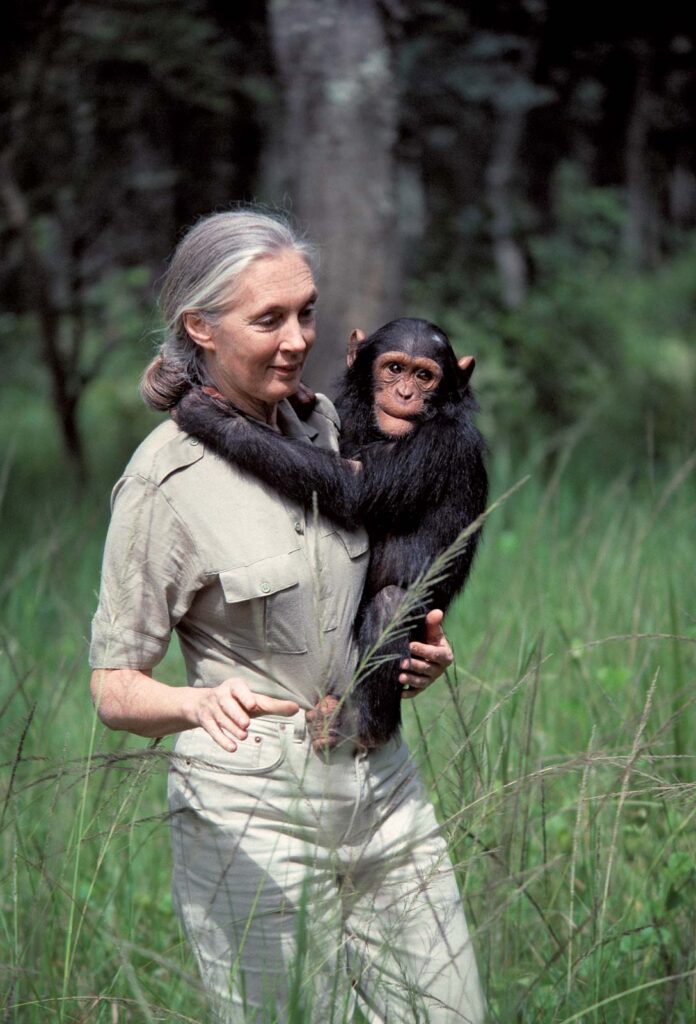
This week, we learnt of the death of Dr Jane Goodall, the primatologist and conservationist. I’m sure most of you will be familiar with some of her quotes, but here are a few I felt appropriate to our gathering.
“Change happens by listening and then starting a dialogue with the people who are doing something you don’t believe is right”
“Each one of us matters, has a role to play, and makes a difference. Each one of us must take responsibility for our own lives, and above all, show respect and love for living things around us, especially each other.”
“We are the most intellectual species to walk the planet, but we’re not intelligent. If you’re intelligent you don’t destroy your only home.”
I also learned this week that the net worth of Elon Musk has risen to $500 Billion.
For perspective, 1 million seconds is around 11 days. 500 billion seconds is 15,854 years (and 8 months).
On the one hand, a life given to listening, to presence, to respect for living things. On the other, a fortune that keeps on rising, measured in numbers almost too large to grasp.
How do we measure a life? By accumulation? By impact? By care?
With these questions in mind return to a photograph I took a couple of years ago, on a beach at Fraisthorpe, on the East Yorkshire coast…

Fraisthorpe is a wide, restless beach where the wind rarely stops. People walk their dogs there, or buy coffee at the Cow Shed café, or simply stand for a while to feel the weather pressing in and the sea air filling their lungs.
Scattered across the sand are the remains of wartime pillboxes and bunkers. Heavy concrete blocks, slumped and half-buried. One tipped into the slope, as if caught in the act of falling. Another still square and stubborn, its edges worn soft by decades of salt, tide, and rain. These structures were built to withstand violence, yet here they are, slowly giving way, folded back into sand and sea.
Not far from them I noticed a bright blue plastic windbreak, striped with red, yellow, and green. Propped against the dunes, abandoned. The fabric lifting and snapping in the breeze. No people in sight. Just that thin barrier against the elements, fluttering, making its own small sound against the roar of the sea.
A concrete relic of war. A plastic fragment of leisure. Side by side. Two human gestures, both temporary, both leaving their trace.
I don’t need to show you the photograph [at the key note – but it is here, of course]. Perhaps you can picture something like it. What stayed with me was the meeting of stories in that place. Human structures slowly folding back into earth and water, yet also the stubborn persistence of what doesn’t fold back. The plastic that endures, almost forever. Annie Leonard (2011) said, “There is no such thing as away. When you throw something away, it must go somewhere.”
That line echoes ominously, when we know that plastic waste has spread almost everywhere. Into oceans. Into rivers. Into fish. Into us. Microplastics have been found in blood, in organs, even in the marrow of our bones. What we throw away finds its way back. The boundary between “out there” and “in here” is not so firm as we might like to believe.
Gregory Bateson once wrote, “The major problems in the world are the result of the difference between how nature works and the way people think.”
That sentence has stuck with me for many years.
And so I find myself asking: how do we think, in therapy?
How do we think about power, about healing, about what it means to be human?
And if our ways of thinking are part of the problem, what might open if we could see differently? If we could relate differently?
The difference that makes a difference
Gregory Bateson didn’t leave us neat theories to follow. He told stories. He offered parables. Towards the end of his life he spoke about something he called sacred unity; the sense that life is not made of separate parts but of relationship, of pattern.
Seen in this way, what we call “pathology” is not a flaw hidden inside a person. It is more like a sign that something in the wider system has stopped learning, stopped adapting.
And I find myself wondering: what if sacred unity is not just a poetic phrase? What if it describes the very fabric of things?
Imagine looking at the world as a quark might. At that level, nothing is solid. What we think of as a hand, or a wall, or even a mountain, dissolves into fields, fluctuations, restless interaction. Boundaries blur. Time itself falters. Labels crumble. Nothing stands alone. Everything moves in relation.
To look in that way is to glimpse a kind of divinity in motion. Divinity, the sacred, isn’t somewhere else. It is here.
Perhaps this is close to what William Blake meant by Fourfold Vision. Not a scheme for organising experience. More like a practice of attending. A way of noticing complexity and entanglement without rushing to simplify.
Blake wrote in a letter to Thomas Butts in 1802:
Now I a fourfold vision see,
And a fourfold vision is given to me;
‘Tis fourfold in my supreme delight
And threefold in soft Beulah’s night
And twofold Always. May God us keep
From Single vision & Newton’s sleep!
These lines have been important to me for many years. They point towards presence and a way of seeing that runs through everything I want to talk about today.
From evolution to exploitation
In nature, evolution is not a contest. It is mutual. An improvisation, always unfinished, between an organism and the environment it belongs to. Fitness in this sense does not mean strength. It means fittingness; being responsive, coherent, in tune with what surrounds you.
However, we told the story differently. Herbert Spencer coined the phrase survival of the fittest, and Darwin adopted it. Very quickly it came to mean something else: the strong defeating the weak. It was taken up as a licence for conquest, for hierarchy, for cruelty.
Bateson respected Darwin, but he also saw the damage in this distortion.
Adaptation was recast as competition. A delicate dance became a race.
And our political and economic systems still carry that story. They run on the survival of the most ruthless. Those who “win” engage in symmetrical battles between one another for control and status, while relating to others in ways that are complementary; servant to master, consumer to corporation, citizen to state.
Given what we now face with climate change, it is hard to pretend this way of thinking still fits. The seas are warming faster than predicted. Weather patterns are shifting beyond expectation. Collapse is not an interruption from outside. It is the endpoint of a way of thinking that can no longer sustain life.
Meanwhile, many Indigenous worldviews have remained close to reciprocity, limits, and interdependence. They still fit because they are woven into cycles of life rather than standing against them.
So perhaps “we no longer fit” could become a way of describing the fracture: between ways of living that sustain relationship with the earth, and ways of living that try to dominate it.
Bateson also questioned the very idea of “power.” He resisted the way we talk about it, as though it were a substance one person could hold, store, or wield over another. To him, that was the same distortion that turned evolution into a struggle. It tempts us to imagine human life as a contest for dominance rather than as an ongoing process of mutual influence and coordination. When “power” or “control” takes the centre of the picture, the patterns of connection fade, and all we see is the pecking order.
For a time, this seemed like an efficient arrangement. Now it is plain that it is far from the way nature sustains life.
And so the question shifts. How do we live with that knowledge? Not in panic, not in denial but with humility. With coherence. With care. With love.
Sacred unity will not give us certainty. But it can give us a way to stay present. A way to hold what feels unbearable. Not alone, but together.
Spoons and billionaires
My sister, Ruth, collects spoons. By now she probably has tens of thousands. She has learning disabilities, and she approaches her spoons with a dedication most chief executives would envy.
She has never harmed anyone. She has never exploited anyone. She simply delights in the sensory feel of spoons – the shape, size and weight, the way a particular spoon rests in her hand.
When I watch her, I sometimes find myself asking: where is the pathology? Yes, when she comes to stay the talk is mostly about spoon shopping, again and again. But she is not hurting anyone with her fascination.
And then I notice how close this looks to the habits of a billionaire. Both gather. Both fixate. Both feel safer when they have more.
But here is the difference: one is labelled disordered. The other is invited to Davos.
This is the distortion again. The way we narrow our field of vision. What we celebrate, what we pathologise, what we choose not to see.
And so I find myself circling back to William Blake and his description of Fourfold Vision…
Fourfold Vision in practice
Blake spoke of Fourfold Vision as different ways of seeing that exist alongside one another.
Single Vision is what he called “Newton’s sleep.” It is a way of seeing that isolates parts and mechanisms. Useful, yes, when we need to plan, measure, or categorise. But on its own, it strips life of wonder.
Twofold Vision brings in relationship. It notices how parts connect, how influence moves between them. Bateson called this double description – the recognition that reality is always richer when we hold more than one perspective at a time. But even here I remain slightly outside the system, thinking about it rather than being inside it.
Threefold Vision brings imagination, memory, experience and subjectivity. Feelings and images seep into what we notice. Past experience colours the present. The unconscious adds its voice. Meaning thickens.
And then there is Fourfold Vision. I must stress here that it isn’t a higher step on a ladder, but a resonance. A felt sense that everything is already alive, already speaking, already entangled. Blake called this “Eden.” Bateson called it “sacred unity.” For me, it is the ground of presence. A way of working and living that lets go of the idea of a detached vantage point. There is only this mutual becoming.
This is not simply abstract theory – I believe it can be the heart of systemic practice, if we choose to work this way.
And it echoes, too, the picture of the quantum world: no isolated parts, only temporary dances of relationship. The self not as a fixed thing but as movement. Reverence not built from certainty, but from wonder.
Nearby is Lake Windermere. I have just driven past it on my way here from Ambleside. A place many of us know well, a place people go for beauty, for quiet, for renewal. And yet, it is becoming full of sewage.
When we pour waste into a lake, when we poison what holds life, we are not only polluting water. We are committing a kind of sacrilege.
Bateson spoke of sacred unity – the pattern that connects all life. To live as though we are separate from that pattern is to forget the sacred. To treat the living world as a dump for our excess is to profane it.
Sacred unity or sacrilege. Perhaps that is the choice in front of us.
A practice of connection
Therapy need not always be about fixing. It can be about remembering.
Re-membering points towards putting back together what has been torn apart. Lorraine Hedtke and John Winslade (2004) wrote about this in relation to grief; how people can re-member those who have died, drawing them back into the ongoing story of their lives.
But I think the idea reaches further. It can be a way of holding paradox, pain, and beauty without rushing to resolve them. A way of keeping open what might otherwise be closed. Allowing all to be members of our life. To do this, we need more than techniques. We need a way of seeing that honours what is alive.
Sacred unity, Blake’s Fourfold Vision, Bateson’s sense of pattern are more than ideas. They can be practices. Orientations. Ways of staying close to what matters when the temptation is to turn away.
An invitation
If sacred unity is real (whatever real means) if connection is something remembered rather than built from scratch, then our task is not to climb higher, not to push harder.
It is to pay attention.
To soften.
To listen for the pattern.
To live and work with complexity, with creativity, with compassion.
Blake wrote:
To see a World in a Grain of Sand,
And a Heaven in a Wild Flower,
Hold Infinity in the palm of your hand,
And Eternity in an hour.
Perhaps this is what systemic practice at its best can invite; a way of seeing that is not trapped in single vision, but alive to presence, alive to wonder, alive to relationship.
I hope this didn’t feel like an eternity to you all.
Thank you.
References/Reading
Bateson, Gregory. (1972). Steps to an ecology of mind. Chicago: University of Chicago Press.
Bateson, Gregory., & Bateson, Mary Catherine. (1987). Angels fear: Towards an epistemology of the sacred. London: Macmillan.
Bateson, Gregory. (1991). Sacred Unity: Further Steps to an Ecology of Mind. Edited by Donaldson, R. New York: HarperCollins
Blake, William. (1802/1980). Letter to Thomas Butts, 22 November 1802. In G. Keynes (Ed.), The letters of William Blake (3rd ed., pp. 101–103). Oxford: Clarendon Press.
Hedtke, Lorraine., & Winslade, John. (2004). Re-membering lives: Conversations with the dying and the bereaved. Routledge.
Leonard, Annie. (2011) The Story of Stuff. Simon & Schuster.
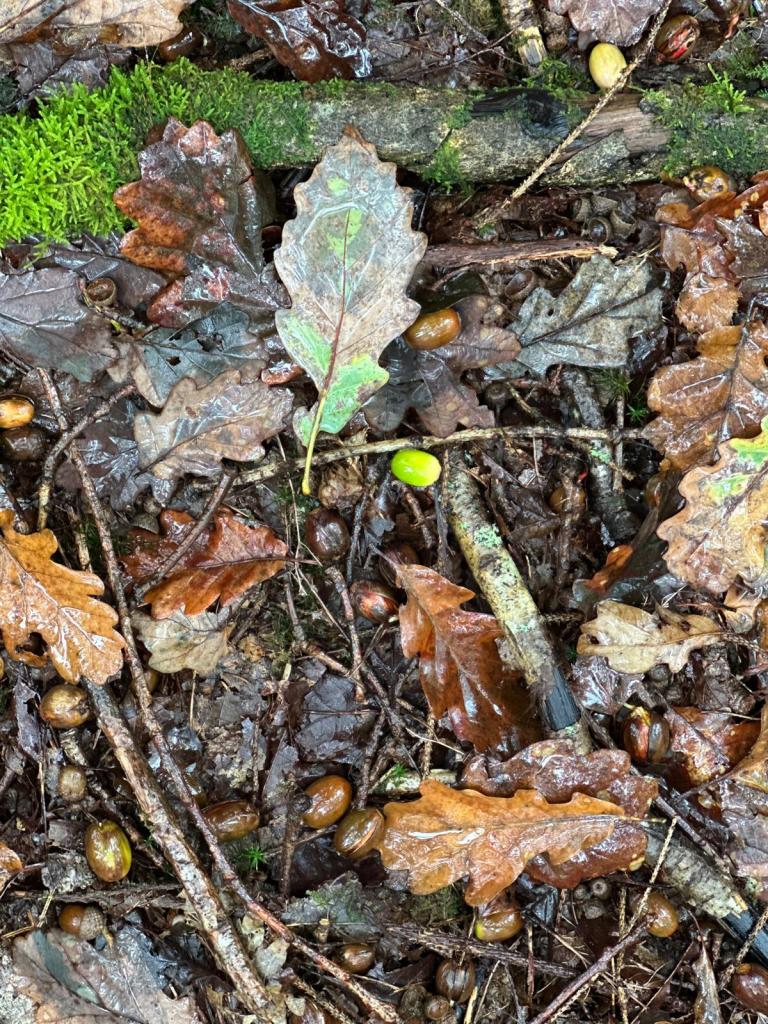
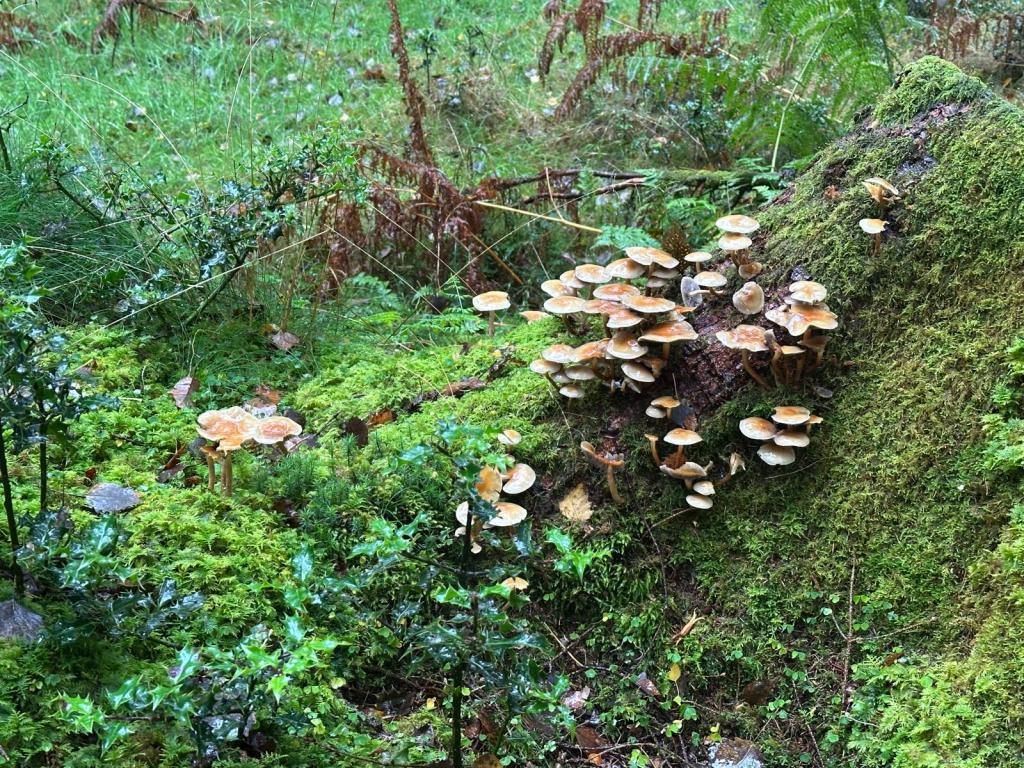
Below are some images I took during a workshop Chiara Santin held in the woodland at Rookhow; 12 acres of ancient oak woodland that is an example of a North Atlantic rainforest. I only wish I could have stayed longer.


 Hugh Palmer